Showing posts with label condiment. Show all posts

Sunday, November 03, 2013

The Quince Connection


Three large quinces I picked up at Greyfriars' House & Garden in Worcester. (The apple and the orange are just there to indicate the size of the quinces)

In Britain, most people know the Edward Lear poem "The Owl and the Pussycat", with its lines,

They dined on mince, and slices of quince,
Which they ate with a runcible spoon 

- but not everyone has seen quinces in real life.
In Germany, everyone knows that they are yellow, because the term "quince yellow" has survived to denote a particularly bright yellow (quittengelb), even though the fruit weren't to be seen anywhere. Until, that is, around 2005, I'd say. Since then I have certainly noticed wide-spread interest in the food blogging community. I also saw my first one, 'in situ' so-to-speak, at another NT property,  Moseley Old Hall near Wolverhampton, around that time. 
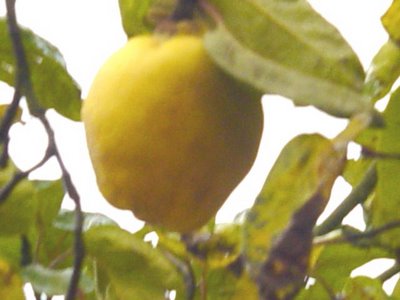

Subsequently, I came across them at farmers' markets here, and this year even at a completely 'normal' market in Frankfurt. And on several stands at that. 

So, they're definitely making a come-back. And quite rightly so. Just having them in the house is uplifting because of their fragrant smell, which Nigel Slater described thus:

 “It's a soft perfume, rose-like, a little sickly but reminiscent of honey, too. 
A scent that marks the start of winter cooking like a tomcat marks his territory.

I made quince & coriander jelly this time. 


My recipe was from: The Complete Book of Preserves & Pickles by Catherine Atkinson and Maggie Mayhew.

They are extremely versatile.Apart from jelly, you can add them to apple crumble, make compote to eat alone, with cream or ice-cream, or stir into yogurt. They can be baked as tarte tatin or as muffins, and even combined with meat in casserole or tagine dishes. Some people also make quince vodka. And let's not forget quince fruit paste - some of you may know this as membrillo.


There are loads of interesting quince entries on the net:
http://www.simplyrecipes.com/quince/
http://cookalmostanything.blogspot.com/2009/05/whb182.html
http://forums.egullet.org/topic/32382-quinces/
http://gomad-ch.blogspot.co.uk/2006/10/day-of-quinces.html
http://culinaryart.wordpress.com/2006/11/03/quinces-in-syrup-with-clotted-cream/
http://forums.moneysavingexpert.com/showthread.php?p=3343535#post3343535
http://www.cottagesmallholder.com/quince-jelly-recipe-102/
http://www.goodfood.com.au/good-food/cook/recipe/ox-tongue-and-quince-tagine-20131031-2wkaa.html


Thursday, May 28, 2009

Heart-of-the-Matter #26: The Locavore - Pink Green


Heart-of-the-Matter is a monthly healthy heart food event hosted by Ilva at Lucullian Delights and Michelle at The accidental scientist, and this month was dedicated to the LOCAVORE. See the round-up here.

When I first saw the word, I thought it was an Italian term, and in my mind, I still pronounce it that way - to rhyme with
amore - whereas here in Britain, it would rhyme with carnivore or omnivore. Which, in turn, gives you a clue as to its meaning, too: eat locally. Ah, don't you just love the unifying traits of the old lingua franca?

But let's see what the actual definition is. According to Wikipedia:

Those who are interested in eating food that is locally produced, not moved long distances to market, are called "locavores," and the word "locavore" is the word of the year for 2007 for the Oxford American Dictionary.

Some people consider food grown within a 100-mile radius of their location local, while others have other definitions.


Sustainability and eco-consciousness have become increasingly important, not just in the United States, but elsewhere, too. In the UK, the 100 mile radius is often seen as too vast in a small country. Consider the central position of Birmingham, right in the heart of England, in the West Midlands:


Can't find it? In the mid-west, just before Shropshire (Shrops) and Herefordshire (Here's) border Wales, there is a blank patch nestling between Worcestershire (Worcs) and Warwickshire (Wars) in the south, and Staffordshire (Staffs) in the north. The only area not being named, that's the West Midlands. (1) West Midlands, as in county, not region, that is. As a region, the West Midlands cover Birmingham, Coventry and Wolverhampton, and all of the above mentioned rural shire counties. So, that's already quite a few counties to choose from. If you apply the 100 mile radius (which you can do for your own area here, by the way), I could buy virtually anything that is produced in England, from southern parts of Yorkshire to northern parts of Hampshire, plus most of Wales.

This would not really constitute 'locally sourced' for a lot of people on this small island. For instance, my son works for the Kitchen Garden Cafe, featured on the Big British Food Map, and I think their definition is very narrow indeed, something like 10 miles. Then again, come to think of it, how does 'locally sourced' differ from 'locally produced'? Could be two different things...

Anyway, even though I bought quite a few food items from Warwickshire and even picked some of my own in Warwickshire, all in all, the dish which emerged for this HotM, does only comply with the 100 mile radius, as the strawberries came from Berkshire. It is called Pink Green because of the pre-dominant colours, and because I noticed a sign for it on the way back from my excursion to Coughton Court. It leads to a cul-de-sac, that much I could tell; there is nothing on the net about it, but I imagine that it might be a nice picnic site. I immediately knew that those would have to be the colours of my creation, as I had already earmarked rhubarb and asparagus, both of which display beautiful hues of the pinks and greens of spring.

  • Asparagus is low in calories (20 per 100g), contains no fat or cholesterol, and is very low in sodium. It is a good source of folic acid, potassium, and dietary fibre. So, very healthy indeed - unless you suffer from gout, that is, because it has a high level of purins. Due to its short season, it often features highly on restaurant menus and kitchen tables alike. In Germany, it is absolutely ubiquitous in May, in a way hard to imagine here (2). Having said that, there are Asparagus Festivals in this country, for instance in Worcestershire’s Vale of Evesham (3). For even more information on the green spears, see here and here.
  • Rhubarb also has virtually no calories (21 per 100g), and is also extremely low in fat, cholesterol (none), salt, and sugar, but provides you with a surprising 7% of your daily fibre requirement per 100g (cf here for more stats).
There are loads of opinions as to how best to cook your asparagus but I have found the English variety pretty resilient, so I don't take any sort of precautions. Ever since Jamie Oliver showed this on one of his programmes, I find the easiest way is to simply bend the asparagus spear at the bottom end, upon which the inedible end snaps off. The rest can go straight into salted boiling water, or a steamer, if you have one - no peeling required.

For this particular meal, I have paired the asparagus with dipping sauces in three shades of 'pink' and drizzled it with an Elderberry Vinaigrette.

Dipping sauces in three shades of 'pink'

(1) Strawberry Béchamel

Puree half a punnet of strawberries.
Make a roux with 1 tbsp of rapeseed oil (4) and 1 tbsp of flour.
Add milk and strawberry puree, whisk.
Add seasonings, e.g. salt, pepper, celery salt...

(2) Savoury Rhubarb and Strawberry Sauce

This was going to be a straight forward rhubarb sauce but the one I did just wasn't the right shade of pink, in fact, not pink at all, rather yellow. As I was also making a rhubarb and strawberry vinaigrette at the time, I saved the purée as a replacement.

Rhubarb and strawberry vinaigrette

1 C chopped fresh rhubarb
1 1/4 C chopped fresh strawberries
3 large shallots, coarsely chopped
1 T local honey (5)
1/3 C red wine vinegar

Simmer in small non-reactive saucepan until tender, about 10 minutes.
Pur
ée, strain into large bowl, and cool. Reserve the liquid for a vinaigrette (just add your favourite
oil and a bit of mustard). Retain the pur
ée as your dipping sauce.

(recipe from: http://www.rhubarbinfo.com/; I used honey instead of sugar)

(3) Balsamic Strawberry Reduction

Sauté 2 shallots.
Add 2 tbsp of white balsamic vinegar, 1 tbsp of local honey, and 2 - 3 tbsp of strawberry purée.
Bring to the boil and reduce.
Add salt, plenty of black pepper and some chopped basil.

This reduction results in a very jammy texture, and like chilli jam or red pepper jelly, goes terrifically well on a bit of goat's cheese.


Elderberry Vinaigrette

I bought a small bottle of sparkling Elderberry pressé at Coughton Court and was thinking of an elderberry foam, but then I saw the vinaigrette in the Waitrose magazine, and adapted that one instead because a vinaigrette is such a classic with asparagus.

3 tbsp Elderberry pressé 1 tbsp lemon juice
1 tsp Dijon mustard
2 tbsp rape seed opil
salt & pepper
parsley & mint

Parsley, mint and chervil are in season in England, but as usual, I couldn't find any chervil. I think I'll have to plant my own!!

Now for the verdict:

All of the tastes and textures brought together in this dish worked for me. The emphasis here is on brought together.
The
Strawberry Béchamel, on its own, tasted too much like a strawberry milkshake for my liking. I deliberately didn't go to town in terms of seasoning because I wanted to retain the delicate fruity flavour, but mixing the purée into a milk-based sauce took away too much of the tartness. I shall try it again as a velouté (using broth/stock/asparagus liquid) next time (which would also make it Vegan friendly).
The
Rhubarb and Strawberry Purée was perfectly balanced on the tart to sweet scale to complement the fresh grassy taste of the asparagus, but minus the vinegar (which had been syphoned off), somewhat lacking in base notes. That's where the reduction came into its own: after a surprisingly strong top note of sweet berry, it mellowed into a rich savoury concentrate of gutsy baked fruit, with a satisfying spicy finish of black pepper.
The vinaigrette could have been zestier, and chervil or even lemon thyme would have provided more interest to an otherwise possibly too delicate taste. None of the sauces, on their own, would have been sufficed as a worthy partner to the green spears, but in combination, they worked a treat.

That strawberries and asparagus are a great combo, I've known since I first encountered food blogging when I stumbled across
Tarte Asperge et Fraise on Chocolate and Zucchini.


Now I need to work a bit more on the rhubarb front. The sauce I originally made is now waiting to pair up with an oily fish, most likely mackerel. So, watch this space!

This locavore edition of HotM has been great fun, so thank you Michelle for the idea and for organising it.
I'm looking forward to the round-up!

______________________________
(1) It's even more complicated than this, and in the past, this part of Birmingham where we live, being South-East, has, from what I recall, been part of Worcestershire and Warwickshire at different times. And don't get me started on rugby or cricket... Warwickshire's cricket ground, is, after all, in Edgbaston, a very short bus ride from here, on the No 1 bus!
(2) If I go over next year for the half term, I must write a feature about the pre-dominantly white 'variety' (which is quite different, in my opinion) and the asparagus madness that goes along with it!
(3) Based at the historic Fleece Inn (NT), in the tiny village of Bretforton, the Festival has grown out of the historic asparagus auctions, apparently. You can even take a guided ‘Asparabus Tour’ - the next (and last one this year) will be running on 3rd June. But the festival stretches into June to includehe Vale Morris, Ale and Cider Weekend on the 20th-21st June.
(4) Farrington’s MELLOW YELLOW®, available at Sainsbury’s and Waitrose, from Bottom Farm in the Northamptonshire village of Hargrave. I already had this in store, and it is gorgeous. It makes a nice change from olive oil which has a very strong own taste. Rapeseed oil has less of a taste and is therefore ideal for substituting butter, particularly in non-savoury dishes. I found at Coughton Court that there is also a Shropshire brand available.
(5) Mine came from the Solihull Apiaries. I don't know whether there is any evidence for it, but there are claims that local honey helps hayfever sufferers in their annual spring and summer battle.

Monday, April 27, 2009

Pickled Pink

Red pickled onion

As soon as I saw the deep pink ringlets on top of a dish, I needed to know what they were, how to get hold of them, or better still, how to make them. Turns out that this eye catching magenta tuft is made by pickling slices of red onions, which renders them translucent, yet opaque, soft, yet crunchy, sweet, yet spicy. I consulted google, of course, and by comparing the first 5 which came up (1), I concluded:


All of the recipes use red onions, obviously, the amount of which ranged from 1- 1 ½ large ones to 1 ½ lbs. Vinegar is another must, with most recipes using white (pickling) vinegar, and only one opting for cider vinegar. Most use sugar and salt, with one each either forsaking the salt OR the sugar.

Four out of 5 used sugar and salt, 2 out of 5 added water.

Beyond that: simply spice it up with whatever you’ve got: allspice berries, bay leaves, black pepper corns, coriander seeds, cloves, cinnamon sticks, chillies, ginger, garlic, juniper berries, lime juice, oregano, thyme, star anise.

This is what I used:

Red Onion Pickle (G & T recipe #4)

2 red onions

Cider vinegar

3 tbsp of honey

Pinch of sea salt

1 tsp of black peppercorns

2 bay leafs

5 allspice berries

5 juniper berries

1 clove of garlic, thinly sliced

5 whole cloves

1 cinnamon stick, broken into pieces

1 dried chilli, broken into pieces

½ teaspoon of dried oregano

1 cup lemon juice

1 tsp of coriander seeds

1 star anise

Thinly sliced pieces of ginger

The methods described varied quite a bit, and I opted – surprise, surprise – for a straight forward, simple one:

I heated the herbs, salt and spices in a non-reactive pan, stirring them with a wooden spoon.

After a minute or two, I added the vinegar and honey and brought the mixture to a boil. Then I added the onions slices, lowered the heat and simmered the mixture for 2 or 3 minutes.


When the pickle is cool enough, it can be filled into jars. It seems to be received wisdom to let it mature for a while. As long as it’s covered by the vinegar, it will probably keep indefinitely.

This vivid pink pickle doesn’t just look spectacular, it is also incredibly versatile. I’ve eaten it with a nice mature cheddar, I bet goat’s cheese is fabulous with it, and I’ve seen pictures where it accompanies roast pork, grilled steak, burgers, Mexican food, and as a side dish to kebabs with a horseradish cream sauce. D.L. even recommends it chopped into potato salad, and he uses the liquid to add tang to a coleslaw. The Boy thinks it’s the delicious pink stuff he had on a noodle dish at Wagamama.

____________________________________

(1) Rachael's site ; Global Gourmet, where they use Mollie Katzen's recipe from Vegetable Heaven, Epicurious, David Lebovitz, Orangette

Tuesday, March 31, 2009

Your garden or mine?

Well, clearly yours, as mine is
a) only a stretch of grass to be used for rugby in winter and cricket in summer, and
b) right at the moment even less inviting, as the neighbours can walk straight into it, because yet another couple of fence panels have been blown over.

So, hopefully, you are, what I am not: a giardiniera. -- The
Italian word 'giardiniera' is derived from the root giardino ("garden"), and literally translates to "female gardener."

Giardiniera

And this is what has been said about the condiment called giardiniera , which I mentioned in my last post:
Giardinera is a wonderful Italian sandwich topping made from olives, cauliflower, carrots and peppers packed in a mixture of oil and vinegar (mostly oil.) It can be mild or hot. Sometimes you can find it chopped and it may be called muffalata. (1)
This is what most Italians think of when they hear the words Sotto Aceti, a collection of mixed pickled vegetables. The standard Italian antipasto misto wouldn't be quite right without these, and they also work very well with boiled meats in the winter months.
... For many Italian beef eaters in Chicago, a lode [sic] of giardiniera atop the beef is as essential as the beef itself. ... giardiniera should not be mild!
This Italian condiment is a Chicago staple. It’s a mixture of pickled vegetables and hot peppers that’s marinated in olive oil and vinegar. Refrigerated, it’s [sic] shelf life is practically unlimited. It’s the best on an Italian beef sandwich but I put it on everything from toast to pasta.

My recipe, once again,
is an amalgamation of many. Googling and comparing 7 recipes, the following standard ingredients were revealed and ranked in descending order:

Olive oil: 7/7

Onions*: 7/7

Olives: 4/7

Cauliflower: 6/7

Carrots: 6/7

Peppers: 6/7

Vinegar: 5/7

Garlic: 5/7

Peppercorns: 4/7

Oregano: 4/7

Salt: 3/7

Jalapenos: 2/7

Red pepper flakes: 2/7

Lemon juice/caper brine: 1/7


* Pickling/yellow/red


Other possible vegetables include baby mushrooms, celery, green beans, zucchini, baby cucumbers, or artichoke hearts. It's clearly a recipe for experimentation.

Giardiniera (G&T recipe #3)

Blitz:
1 tbsp green olives
½ cup cauliflower florets
1 carrot
1 red pepper

1 green pepper
½ onion
½ zucchini
1 stick celery
1 green hot chilli
Boil:
1 cup white vinegar
Add:
Blitzed vegetables and
1 bay leaf
tsp pepper corns
1 tbsp dried oregano

Boil for 15 minutes Add:
2 tbsp of chopped capers
1 tsp of dried chillies and

1 tsp salt
1/3 cup of olive oil

Fill into sterilised glass jars. Don't put it all into one big jar, you'll be better off using several smaller jars because the contents of an open jar lose their freshness. As I wanted to keep the mix indefinitely, I topped them up with more vinegar, so that everything was well covered. Most recipes will advise you to leave the giardiniera to mature for 48 hours to 1 week before using.
Mine is pretty vinegary, which I love, but some people would probably be happier with less vinegar and more oil.

PanNan on Recipezaar recommends giardiniera with cream cheese on a cracker. I tried it with mine but found it's too vinegary for that.

PS: The photograph of the flowers along the garden path was taken in Monet's Garden.

__________________________
(1) I mentioned it as 'muffuletta' here (Feb, 17th) - see more here about the bread, salad and sandwich, and the endless spelling variations.