Wednesday, February 04, 2009

Snowballs on Ice


Just a snapshot in Canon Hill Park yesterday. (For the Cocktail, see below!) I was lucky enough to be able to spend the day in the snow with both my boys. One had the day off anyway, and the Birmingham schools were closed, too. Apparently, the Midlands were least affected by the snow, and nice as it was, it has to be said: it wasn't a lot. This amount would never warrant 'no school' in Germany. Mind you, the kids would be able to enjoy it anyway, with lessons finishing at 1:30 the latest. (Unless you go to a Gesamtschule , a school based on a Comprehensive; and there aren't many of those about.)
It is a source of never ending amusement to me, how there's method in this madness of maintaining the myth that it never snows in this country. Not often enough to have enough snow ploughs anyway, or any other policies concerning snow. I'm not complaining!! If this were Germany, I would have been forced last night to go out (again) and remove all snow and ice from the pavement in front of the house. As a house-owner, or a resident of a ground-floor flat, it's your liability if someone slips and injures themselves.
I think it's also law by now that, during the months of October to April (or thereabouts), cars have to change their tyres to the winter variety. Whereas here, they gave me a look normally reserved for the mentally insane, when I inquired about winter tyres!

For the Cocktail,
you need 2 shots of advocaat over ice in a long-drink glass, top up with lemonade.

Did you know that 'advocaat' is so-called because it was originally made from avocados? Want to make your own advocaat? You can check it out in an old post of mine: December 2005 - Was mache ich mit dem Eigelb? (What do I do with the egg yolk?)
[I wish I could just link it, but alas, that's far too technical for little me....] [edit, 02/09]


Saturday, January 31, 2009

Thyme and Thyme Again? BDD #16 Bread With Cheese


Parsnip & Parmesan Bread
(adapted from Delia Smith's recipe in HTC book 1 & her Vegetarian Collection)

for Bread Baking Day#16
(check out:
hoghigh.blogspot.com/)

I made this for our Burns supper (see last 2 posts), to go with the leek and potato soup, which was seasoned with rosemary and thyme.

Delia's recipe is with sage, a taste I'm not that keen on, so I used thyme (again) and parsley, and I also added garlic. The latter two mainly because I wanted them to feature in the look of the bread. I saw this on someon
e's blog and I thought it looked terrific.

Ingredients:
175g parsnips (peeled weight)
50g Parmesan (5 mm cubes)
1 tbsp thyme
1 tbsp parsley
1 clove of garlic
225g self-raising flour
1 1/2 tsp salt
2 large eggs, beaten
1 tbsp milk

topping:
parmesan shavings
1 clove of garlic
parsley
oil,
flour

You need: a small solid baking sheet
Pre-heat the oven to Gas mark 5, 375°F/190°C


Sift the flour, add the salt. Grate the parsnips coarsely, add to the flour together with the parmesan, thyme, parsley and finely cut garlic. Mix, then add the eggs and the milk. The dough should be rough, loose, sticky. Pat it on to the baking sheet into a 15 cm round, make a cross, scatter the Parmesan, sprinkle with some flour. Dip the parsley first into olive oil then into flour, arrange on top. Stick the whole garlic clove in the middle. Bake on a high shelf for 40 - 45 minutes.

Verdict: All in all, a success. It looked great and went reasonably well with the soup - a touch too sweet maybe. As I never tasted the original, I don’t know whether the sage tones the sweetness of the parsnips down, or whether thyme and garlic add even more. I would definitely bake it again, maybe to go with a more peppery, tomato based soup. The parmesan shavings on the outside were delicious.

Thursday, January 29, 2009

Leeky Pot, Parsnips and Parkin - or how to get the 60s, 70s and 80s into one posting


This is what the chicken stuffed with haggis (see last posting) looked like (1), and we all enjoyed it immensely, even though the boys had been sceptical beforehand: one communicating this with facial expressions hovering between disbelief and disgust, the other one declaring it 'bizarre'. And if I say 'all', I have to exclude my MIL, who could not make it, and the Crown Prince's girl-friend No3 (2). Not having learnt from last Sunday when he left a garbled voice message on the house-phone that girl-friend No1 has turned Vegan, he had again omitted to tell me that this girl is Vegetarian. Had I known beforehand, I could have tried out McSween's Vegetarian Haggis and made her a Savoy Cabbage Roll. As it was, she had to make do with the vegetables and mash. She really enjoyed the Whisky sauce though, which was rather delicious, even if I say so myself.

In wise anticipation, I had decided to turn the traditional cock-a-leeky soup into a Vegetarian pot-a-leeky, or 'Leeky Pot' (3), just in case, which was very well received, as was the Parsnip & Parmesan Bread (adapted from Delia Smith, recipe to follow shortly for Bread Baking Daily#16).

For the chicken, I used my Römertopf (4) for the first time in decades; my oldest recited the few lines of Burns he knew (which weren't from the ode to a haggis), and my BH played Alex Harvey (5), which was the best he could come up with in place of bagpipes.

We rounded the festivities off with the tipsy laird trifle. It was very nice, though I wouldn't use Parkin again instead of trifle sponge. I wanted something oaty, but the Parkin is too gingery, something with less of a taste of its own would have been better (Dundee cake maybe, to stick with the Scottish theme?)

________________________________
(1) In case you have noticed the tartan tablecloth: that’s actually just a piece of material, which I bought to make myself a Western style blouse, back in the early 80s. Just one of the many unfinished (in this case, never started) projects of my life. Apparently, apart from ‘Camel Thompson’ (or Mackenzie), there aren’t any brown tartans; I checked them all! The Burns one has a red background, check it out here. It’s something to do with the Clan Campbell and applies to the names of Burns, Burness, Burnes, Barnes, Burner and Burnhouse. The word “burn” is an OE word for stream, still commonly used in Scotland.
(2) The numbering system is purely chronological. It is not very likely that girl-friend No2 is going to turn up again, mainly because girl-friend No1 has always featured, however infrequently. It’s a polyamorous thing, a bit like free love in the 60s (maybe more about this some other time..)
(3) A very basic soup: onions, 2 leeks, 2 potatoes, marigold vegetarian stock, garlic, nutmeg, seasoning; but the tip taken from Alex Jamieson's Great American Detox Diet, Rodale Press, 2005, to add the rosemary and thyme only just before the blending process, was a revelation. (She is a Vegan chef and the fiancee of the maker of the film, Supersize Me.)
(4) It's an earthenware casserole dish, which was very popular in Germany in the 70s. It has to be immersed in water for 15 minutes prior to use, it goes into a cold oven, and the desired temperature is reached in 3 stages. It cooked the chicken beautifully - mind you, they were M & S 'succulent' chicken breasts, so maybe not all the credit goes to the R
ömertopf.
(5) Scottish rock and roll performer (1935 - 1982)

Thursday, January 22, 2009

Burns Treatment


It's Burns Night on Sunday, and this year it's particularly special because it's the 250th anniversary of the Scottish Bard.

Burns, who died when only 37, penned more than 400 popular songs, and amongst his best known pieces are
Auld Lang Syne, A Red, Red Rose and To A Mouse.

Auld Lang Syne is, of course, traditionally sung at the stroke of Midnight on New Years' Eve, not just in Scotland or the British Isles, but in other places of the former Commonwealth, too, I believe (1).
A Red, Red Rose is probably why Burns is regarded as a pioneer of the Romantic movement, and likewise why Romanticism and the term 'romantic' is nowadays equated with 'kitsch' and roses, when really, it was much more than that, with men like Burns and Blake inspiring both liberal and socialist thought.
To A Mouse not only starts with a personal favourite, "Wee sleekit, cow'rin, tim'rous beastie", but also contains the much better known line: "The best-laid schemes o mice an men/Gang aft agley" (often incorrectly cited as: 'The best-laid plans of mice and men/ Often go awry'), which provided Nobel Prize winning author John Steinbeck with yet another unforgettable title. Incidentally, we are going to see Of Mice and Men (2), produced as a play at the Crescent Theatre tomorrow. You'll be able to read my review soonish, either here or in a new blog.
For January 25th and the so-called Burns Suppers, it is, of course, To A Haggis, which is instrumental.
According to
Wikipedia, Burns Suppers are celebrated around the world, in fact, are more widely observed than the official national day of Scotland, Saint Andrew's Day, or the proposed North American celebration of Tartan Day.

The ritual of Burns Suppers
(3) was started by close friends of Burns shortly after his death in 1796, and its basic format has remained largely unchanged. After the Chairperson's opening address, the company are asked to stand to "receive the haggis", which is carried to the top table by the chef to the sound of bagpipes and the guests' slow handclap. Burns' famous poem is then recited by either the chairman or an invited guest. Upon reaching the line, 'an cut you up wi' ready slight', the haggis will be cut open with a sharp knife, which is followed by applause. The company will then stand and toast the haggis with a glass of whisky.

The typical
"Bill o' Fare" would be Cock-a-leekie soup, followed by Haggis, Tatties and Bashed Neeps. For afters, there'd be Tyspy Laird (sherry trifle) and A Tassie o' Coffee.

But my recipe for Burns Night is:

Breast Of Chicken With Haggis In A Whisky Sauce
(G&T Recipe #1)

My BH, forever 'stationed' in such exotic places such as Blackpool, encountered some such creation just outside the infamous seaside resort, namely in LYTHAM ST ANNES , and came to love it, so much so that he invited us up there, with the main intention to take us to that restaurant - BISTRO GERRY - so that we could sample it. (4)

I loved it, too. So, last year, I researched it, and this is my recipe -- an amalgamation of a variety of googled online suggestions. (5)


1 breast of chicken per person
ca 1 slice of haggis per person
(6)
onions, thyme
2 tablespoons of oil
Sufficient bacon/pancetta/Schinken
(7) to wrap each chicken breast

sauce: for 4
Shot of whisky per person (ca 25ml)
12 fl oz double cream
20 fl oz brown stock
Seasoning


Heat 1 tsp of oil in a frying pan set over a low heat. Soften the chopped onion and thyme, stir in the crumbled haggis. Set aside.

Slice the chicken breasts so that they open like a sandwich, stuff each breast with haggis, onion and thyme mixture, close and wrap each chicken breast in bacon/Schinken slices.

Cook, covered, in an ovenproof dish in a moderate oven for an hour (turning periodically), then remove the cover and crisp the bacon for about 30 minutes.

Put cream and whisky in a saucepan, bring to the boil and reduce to half the original quantity. Add stock, bring back to the boil and season. If the sauce is too thin, add a little corn flour. Pour sauce on a plate, slice the chicken and arrange on top of the sauce.

Serve with turnips (neeps) and potato mash (tatties) and green vegetables.


***

If I do go ahead with a 'Typsy Laird' Trifle, I'll probably be using Scottish raspberries and Drambuie.

***

I am not quite certain what Scotland's first ever 'homecoming year' actually means but apparently, Rabbie Burns is more controversial than you'd think. Most of the following is from news.scotsman.com.

On January 5th, Susan Smith reported that a leading historian argued, Robert Burns was a
"racist, misogynist drunk" who is unfit to promote Scotland's 2009 Homecoming celebrations. The historian who pointed to Burns' moral shortcomings was Michael Fry. Clearly, other people do not share this opinion, the National Trust for Scotland for one. They will be publishing his letters from the years 1787-1789 online (each one on the day it was originally written). They kicked off in December with Burns confessing in a letter to Captain Brown that he is

"ready to hang [himself] for a young Edinburgh widow, who has wit and beauty more murderously fatal than the assassinating stiletto of the Sicilian Banditti, or the poisoned arrow of the savage African."

Hmm, I think we get the picture.


PS: I have just found out that there are first-class stamps featuring Burns on sale as of today. Apparently an honour that no other non-royal person has ever achieved!
_____________________________________
(1) Interestingly, it was one of the songs that we, a class of German school-girls, sang at a school in Rye/Sussex in 1972 - presumably to show off our superb grasp of a foreign language - not at all realizing that this is a song for New Years' Eve! I wonder what the hosts thought of it. My friend, Big E, and I made quite a fuss of enacting the "And there’s a hand my trusty friend ! And gie's a hand o’thine!", and we still consider it, to this day, OUR song!
(2) A 1937 novel, about two displaced migrant workers during the Great Depression in California; very tragic and very topical
(3) All the following information is taken from here: http://www.rabbie-burns.com/
(4) 345 CLIFTON DRIVE SOUTH, LYTHAM ST ANNES, LANCASHIRE, FY8 1LP Tel: 01253 723511; chef: Gerry Soutar. Other than the terrific food, Blackpool itself was an utter disappointment. As it was, we had a room with a view in the Blackpool Hilton, only there was no view at all! Thick fog completely and utterly disguised the fact we were at the seaside. Even the tower was shrouded entirely!
(5)It's what I like doing. I like to find what you might call the essence of a recipe - the absolutely agreed components, if you like - and then tweak it according to my liking and/or requirements. The latter, for instance, may be to cut out unnecessary fat/calories or food my BH isn't supposed to eat because of his heart condition. I shall call them my G&T recipes (googled and tested) from now on.
(6) The Robbie Burns Society reckons that Macsween of Edinburgh means haggis in Scotland almost exclusively, and that's what I bought; available at Waitrose.
(7) I use Schwarzwälder Schinken from Lidl because it is the thinnest cut and does the job really well without adding unnecessary calories.

Thursday, January 15, 2009

Tartiflette Au Pif


My youngest had Rugby County trials yesterday and had asked me to make him something really nice for his return. So I thought of the tartiflette that our friend Anatole had baked for a party, a dish greatly admired by my 14-year-old. Rich and comforting, just the thing my aspiring Tiger/Lion/Dragon (1) would hope to indulge in after a long hard day in school (he gets up at 6:30) and on a freezing (but hopefully not frozen) rugby pitch (trials starting at 5:30 in the afternoon, no time in between to come home!) .

When I researched the recipe on-line, I found quite a few variations - the Waitrose recipe, anachronistically, featured mushrooms (and my boys hate fungi), quite a few contained some form of cream, and some even white wine or dry vermouth - but when I asked A. for his recipe, his answer was this:

Pour la recette de la tartiflette, c'est un peu au pif, mais c'est tout simple: d'abord faire cuire les pommes de terre découpées, les oignons et les lardons à la poële; ensuite mettre les pommes de terre au fond, les oignons et les lardons dessus, et à nouveau des pommes de terre sur le dessus; découper un Reblochon en deux dans la hauteur, et les poser sur le dessus; et mettre à cuire au four, jusqu'à ce que le fromage soit fondu.

That's more like it: Sliced potatoes, onions, bacon bits, first fried, then laid out in an ovenproof dish, potatoes first, then onions and bacon bits, then another layer of potatoes. Finish with Reblochon, cut in half. Bake until cheese has completely melted.

But how many potatoes, onions, lardons? And what the heck is 'au pif'? Ah, that's just it... When I looked it up, there was a whole web discussion in the on-line dictionary. Apparently, the expression is used for those dishes one cooks not according to any set recipe but by instinct and experience (i.e. everything my BH cooks and most family dishes...):

'at a rough guess'/'nach eigenem Ermessen', 'according to preference'/'nach Belieben'.

Without the experience, I had to go back to the other recipes for that 'rough guess'. Unsurprisingly, they didn't just differ greatly in terms of ingredients and amounts, but they also used different methods! Whether you slice, dice or mince your onions, or which type of bacon you use, may be a matter of taste, but whether you boil your potatoes (peeled or in their skins) beforehand has consequences!!!
There wasn't even one agreed method as far as the deployment of the Reblochon is concerned but I think putting the whole cheese on top, sliced lengthways, sounds the most authentic
(2).

What follows is a summary of various recipes:


The 4 basic ingredients are:

  • Potatoes, waxy, such as Cara, Desirée, Charlotte
  • Onions
  • Bacon
  • Reblochon (if you cannot get hold of Reblochon, the following alternatives have been recommended: Crémier de Chaumes, Epoisses, Pont-l'Évêque (3) or even a mature Irish Ardrahan)

To serve 4 - 6:
  1. 25 - 50 g butter, depending on whether you need it just for greasing or for frying the onions and bacon
  2. 175g - 250g bacon (ca 2 thick rashers of smoked streaky bacon) or pancetta, cut into 1cm lardons
  3. 500g - 1.5kg potatoes
  4. 1 large or 2 medium white onion(s), diced or finely sliced or even minced
  5. 1 ripe Reblochon cheese (ca 250g)
  6. Salt and freshly ground pepper
Optional:

Oil for frying, if not using butter
1 garlic clove, peeled and cut in half, for rubbing the baking dish
568ml carton single/double cream/2 tablespoons crème fraiche or chicken stock
1 glass - 1 bottle of dry white wine

You will need a shallow baking dish (about 25 x 30cm).

Method:

Preheat the oven to 150°C/gas 2 - 200°C/400°F/gas mark 5.
Rub your dish well with the halves of garlic, if using.
Grease with the butter.


Bacon and onions:

Heat a frying pan over a medium-high heat. Add the bacon and onion. Sauté over a medium heat; they should sweat but not brown. Season.

Potatoes: (4 methods)

A: Toss the potato slices (ca 3mm) with salt and pepper.
B: Sauté the potato slices.
C: Peel the potatoes, then boil. When finished, drain and leave to cool (do not refresh!!!).
D: Bring a large pan of water to the boil and cook the potatoes whole, in their skins, for 15 minutes. Drain the potatoes and as soon as they are cool enough to handle, peel them. Slice.

Arranging the ingredients:
  • Arrange half the sliced potatoes in a layer to cover the bottom of your dish, season, then scatter over the onion and bacon mixture.
  • Add the remaining potatoes and more seasoning.
  • Pour enough cream or chicken stock, if using, over the top to just cover the potatoes.
  • Add a glass of dry white wine, if using. Top with the Reblochon.
  • Dot with the remaining butter (optional).

Baking:

The idea is that the Reblochon should melt and drip down while the potatoes go crisp. But because of the different methods, as outlined above, the length of the process and the required temperatures vary, from 30 - 35 minutes when using pre-boiled potatoes (bake at 200°C/400°F/gas mark 5 for 10 minutes, then reduce the heat to 180°C/350°F/gas mark 4 for a further 20—25 minutes), to 1 ¼ hours in a really warm oven (220-250°C or 428-482°F).

Remove from the oven, cover with foil and leave for 10-15 minutes before serving.


What I did:

I bought the lardons (smoked) and the organic Reblochon from Waitrose, I already had salad potatoes in. My oven proof dish was only 20cm x 25cm, but did the trick. I used garlic and unsalted butter. I cut 2 onions into slices and halved them, I first ventured to peel the potatoes but gave up after the first one. I fried the lardons and onions without oil or butter, just adding a bit of water when it became too sticky. Even though I had read and written out the recipe before, I made the mistake of adding the potato slices to the same pan, so when it came to arranging the potatoes first, it was messy (thank God for my asbestos fingers!), but I did it, and just before 7, I put it in the middle of the oven (no liquid or fat other than the Reblochon added), at about 190C, and set out to find the rugby club, where the trials were held. We came home at 7:45 to a gorgeous smell, the Tartiflette was slightly overdone, I'd say (this bottom heat oven takes some getting used to!) but even though it was only the 2 of us, what you see above, was all that was left! Yuuuuummmmie!!! (Is it 'miam miam' that the French say?) So, thank you Anatole, and thank you, Reblochon Trade Union!

__________________________________
(1) Recently, he had to write an autobiography, set in the future. He entitled it: "My life as a tiger, a lion and a dragon". The references in this great title are, of course: Leicester Tigers, the British and Irish Lions, and the Welsh Dragons...
(2) According to this, Tartiflette is a French dish from the Savoy region. "Historically, the tartiflette originates in the valley of Aravis, home of the Reblochon cheese. However, it is not a traditional dish and was in fact invented and launched only in the 1980s by the Trade union of the Reblochon in order to increase sales of the cheese. Different valleys in the region have different methods of producing Tartiflette and there may even be one recipe per village."
(3) This cheese occupies a rather special place in our lives..., according to my off-spring, it isn't called 'pong' for nothing!
pong: –noun, an unpleasant smell; stink; –verb (used without object), to have a disagreeable smell; stink. 1915–20; of obscure orig.
The one my BH brought back from the French market had to be banned from the fridge and currently resides, inside 2 tupperware boxes, on the cellar stairs!

Friday, January 09, 2009


Jan, 9th
Christmas!


No, I'm not confused or mad (though my family might contest that), I know that even for the Orthodox and the Armenians the Nativity was a few days ago (1). But not only did we have snow on Tuesday (which reminded me of a late January or early February when my youngest experienced snow for the first time - he threw his arm in the air and exuberantly exclaimed "Christmas!"), no, yesterday our parcels were finally delivered! Two big presents - an x-box and a dyson - which my BH had ordered at the end of November!! -- Don't ask! It's one of those tangled webs in which every protagonist, as frantically and insufficiently as Adam and Eve in Paradise, tries to cover up their shame. With threads of narratives instead of fig leaves, as it were.
But hey, I'm all in favour of moving the feast! Further away from our birthdays for starters (mine and my first-born's on the 23rd). Then there is the much higher chance of snow in January - it is, after all, on average, the coolest month of the year within most of the Northern Hemisphere (2). And think of all the Christmas bargains! You don't even have to leave the house and join the mammon worshipping hordes (except for the groceries) - just type 'unwanted gifts' into ebay, and pay less than half price for all kinds of presents that some poor soul has gone through agonising buying decisions for, not to mention the further pain of parting with money far too good for the items, just to find their relatives and friends flogging them at the a starter price of 99p. You'd be amazed at what some people don't seem to want, or claim they already have lots of (brand new ipods, iphones, laptops)... And even more amazed by the amount of 'Secret Santa' presents, just how many people bid on them, and by how much!

But I'm digressing as usual. The above mentioned lateness and incompetence makes me feel a bit better about being behind the times again with my first
January Recipe:

a traditional Kings' Cake. (3)

I wrote about the cake and the three magi in January 2006, and there is a lovely article here:

Epiphany, le jour des rois, Heilige Drei Könige, el Dia de los Tres Reyes, or even (mistakenly) Twelfth Night - call it what you will - was of course on the 6th. But various activities (see above) prevented me from baking it until the 7th, and writing about it until today. Not that I need to feel totally out of synch because of it - the whole period between Epiphany and Mardi Gras is sometimes known as "King Cake Season" in places like Louisiana. Mind you, The Louisiana King Cake is more of a bread, and because of its link to Mardi Gras, it features the Carnival colours: green, yellow and purple.

The Kings Cake I baked was in the French (and Tudor?) tradition:

GALETTE DES ROIS
(Kings' Cake)
Eric Lanlard from Good Food Live


Ingredients
125g caster sugar
125g ground almonds
125g unsalted Butter, softened
3 Eggs
1 tbsp dark rum
500g Puff pastry, (ideally made with butter)
sugar syrup, for brushing

For the egg wash
1 egg yolk
1 tbsp Milk


Method
1. In a mixing bowl mix together the sugar and ground almonds.
2. Add the butter and cream it together until thoroughly mixed.
3. Beat in the eggs one by one, mixing thoroughly between each addition. Mix in the rum.
4. Divide the puff pastry into two even portions. Roll out each portion and cut out two puff pastry circles, each 25cm across and 3-4mm thick.
5. Place one puff pastry disc on a baking sheet lined with baking parchment.
6. Make the egg wash by beating together the yolk and milk.
7. Spoon the almond cream into the centre of the pastry disc, leaving a 5cm edge.
8. Brush the edges of the pastry disc with the egg wash.
9. Place the other pastry disc over the almond filing and seal the edges together firmly.
10. Chill the Galette des Rois for 1 hour in the refrigerator.
11. Preheat the oven to 180°C/gas 4.

12. Brush the Galette des Rois with the egg wash. Using a small, sharp knife cut the edges into a scallop pattern. Using the tip of the knife cut a sun ray pattern on the top.
13. Bake the Galette des Rois for 40 minutes, until golden.
14. Remove from the oven and brush at once with sugar syrup.
15. If eating the cake to celebrate Epiphany add a small ceramic figure to the almond mixture. Traditionally whoever finds the figure in their slice of Galette will be the king or queen.


Things I changed:
1) After watching videos on how to prepare a Galette des Rois on You Tube, I used Amaretto instead of rum, but I think, next time I'll use rum for more depth. As usual, any alcohol may be substituted - one girl on You Tube used Kirsch!
2) I used a pastry implement to make a pattern (not a sun ray, just criss cross), and yes, it's very important not to pierce the top - the frangipane will ooze out (as happened with mine as you can probably see)
3) I didn't have a ceramic figure or dried broad bean, so I used a dried kidney bean instead; worked, too.


Other things I would change:
It really doesn't need quite such a large amount of frangipane mixture for my liking. So I would use only half the amount for the same size cake. My mixture was also much softer than those shown on You Tube, so I might only use 1 egg next time.

I also need to make a note to self: 1 tbsp of sugar with 1 tbsp of water is enough for the sugar syrup.

Tastewise, I was very pleased with the result, and my BH was particularly fond of it.


So, hopefully, this will become a tradition in our household. Just remains to research the link. On TudorTwelfth Night (defined by the Oxford English Dictionary as "the evening of the fifth of January, preceding Twelfth Day, the eve of the Epiphany, formerly the last day of the Christmas festivities and observed as a time of merrymaking"), a cake which contained a bean was eaten and whoever found it would preside over the feast as King of the Bean. It marked the end of the winter festival (the start of which was All Hallows Eve - Halloween), and had strong elements of the Lord of Misrule tradition (as present in the Celtic Samhain or the Roman festival Saturnalia). The world turning upside down for a day, i.e. reversing the pecking order, with those at the top becoming the peasants and vice versa, can be traced back to pre-Christian European festivals, and is still present to this day during other feast days (May 1st, in places, or Altweiberfastnacht during the German Carnival) (4).
Shakespeare's Twelfth Night or What You Will also features elements of reversal, such as Viola dressing as a man, and Malvolio, the servant, imagining that he can become a nobleman.
Interestingly, it is recorded as having had its first performance on
Candlemas Day 1602, the festival which some cultures deem to be the real end of the celebrations. This is why the greenery put up at Christmas is taken down at Epiphany in some European cultures, whereas in others it remains up until Candlemas. As if there were not enough confusion without this (5), it is further complicated by the circumstance that the exact date of Candlemas depends on whether you ask Western Christians, Orthodox Christians, or Armenian Christians. Maybe a bit more about that in February...

But before that, there's Burns Night...

____________________________
(1) More about that and Candlemas further down...
(2) Charlemagne called it Wintarmonath (winter month), the Finnish call it the month of the heart of winter (tammikuu), and the Czech go even further by calling it leden, meaning ice month. (cf Wikipedia)
(3) The Gâteau des Rois in Provence or the Galette des Rois in the northern half of France and Belgium.
(4) You'll just have to wait...
(5) Telegraph, Jan 5th, 2009, Christmas ends in confusion over when Twelfth Night falls (By Martin Beckford, Religious Affairs Correspondent): "...many people believe Twelfth Night falls on Jan 6, at the end of the 12th day after Christmas, and so keep their decorations hanging in their homes for an extra day. The difference in opinion is said to be down to the fact that in centuries past, Christmas was deemed to start at sunset on Dec 24 and so the 12th night following it was Jan 5. Nowadays, people count from Dec 25 and so assume Twelfth Night falls on the 6th.
Adding to the confusion, however, most of England's churches remain decorated beyond Twelfth Night so that they can use crib scenes in Epiphany services." ... "A spokesman for the Church of England said: "Twelfth Night is the night before Epiphany and is the night, tradition says, when Christmas decorations should be taken down."
And this is just the confusion about Twelfth Night/Epiphany! I have found online opinions which suggest taking the decorations down as early as Boxing Day!! That's preposterous, of course, and would only make any sense in those cultures where they go up as early - apparently - as Thanksgiving Day (4th Thursday in November)! In Germany, where the tree isn't brought in from outside until the morning of Christmas Eve, discarding it on Boxing Day would be an awful lot of expense and effort for an awfully short time!
Well, my decorations are down but not packed away yet, as would befit our forever chaotic household, in which it is forever Christmas (more about that some other time...), but which, according to another superstition I found online, is a very bad omen: "My grandmother said to take them down by New Year's Day or you'll be lazy all year"! (It would explain the story of my life...)
In Germany, by the way, there was a special refuse collection for Christmas trees on January, 6th. So unless you wanted to dispose of it yourself, you made sure it was bare by Twelfth Night. Not that I've ever heard anyone call it that there! But I did come across a mentioning of The 12 Dark Nights recently..., so maybe a spot of further research is needed!


Thursday, December 07, 2006

Three Things A Day

Today's entry is inspired by Joe Hyam from Now's The Time, which was itself inspired by Clare's blogspot. (Sorry, can't be more specific than that. )
Every day, he describes three things - things that delight or amuse him, things he finds beautiful.
What a wonderful idea, I thought. Maybe something like that would revive my feeble blog, which was never supposed to be just about food anyway. And let's face it, there are more excellent food blogs out there than you could ever read, even if that was your preferred pursuit when trying to escape the call for more important things to do. (Too numerous to mention...)
And all the while I marvel at just how wonderful and inventive other people's food creations are, and despair over just how dull my photographs are in comparison to the absolute masterpieces other people produce, I
don't get round to writing my own entries.
So, a few words on nothing more than three noteworthy things struck a chord with me, especially as no photographs are required. (Having said that: Joe does have some, in fact, check out his marvellous puddle photo.)
Of course, it wouldn't be three things a day, that would be far too frequent. A chore, a straightjacket, far too consistent. (The only thing I'm consistent about is being inconsistent.)
It wouldn't exclusively be about beautiful things either. Life is not just about beauty and wellbeing. There is also a lot of sorrow and a lot of anger. - Ah! Now you can see where this is going, can't you ?
"Disgruntled from A.G." - "Zabeena's Daily Bellyache" - "Three Axes I have to Grind"
Whinge, Whine, and Whimper; ... the Triple Thump: Rile, Rage, Rant; ... the Helly Trinity: the Gripe, the Groan and the Grumble...
Any three things really... it's a magic number (and not only since this was used as a slogan for some programme or other, as one of my students thought... where exactly do they breed these imbeciles??!! ).
So, let's see, what's been bugging me today

Expectations
... the fact that I have them and that all too often they are not being fulfilled by other people. The question being, am I too demanding or are other people too selfish? Well, clearly, other people are too selfish. Certainly from where I am sitting. Under the coat of self-preservation, the mantle of lame excuses, the cap of indifference, they hurt me, hurt me deeply, hurt me more than I'd ever willingly disclose. And if I told them, if I ever expressed what their lack of love, their literal carelessness, their callousness does to me, they still couldn't bring themselves to say sorry. Because their world is so different from mine that they'd even argue that I ask too much of them, that I'm unreasonable, that I am selfish. Not so. I am not expecting what I wouldn't do, what I'm not willing to give, what I haven't done many times before in the past, what I'd never hesitate to do. That and a lot more. And that's why it hurts. That they are never ever able to put themselves second - let alone last.
But I won't beg, and I won't bid. That's just not me.
But I won't forget and I won't forgive.
I'm afraid, that is me.

Slaves
... when there were real ones, at least they were an asset, as in: an investment, and therefore looked after, whereas lowly paid staff are dispensable. At my own place of work they wring everything out of me, now even shifting part of their admin, not only in terms of time but also resources, from full-time, properly paid staff with pension schemes and increments, holiday and sickness pay, and opportunities to progress and eligibility for training courses, to part-time, seasonal staff with, well, none of the above. I 'm obviously supposed to print this stuff out at home, i.e. on my printer, my cartridge, my paper, not to mention my internet connection that makes this possible, and then to photocopy it in my own time, which is paid on a pro rata basis. This basis being the actually taught hour. Are you still with me? 'Taught' is the instrumental word here. Just how many hours do you think would be reasonable to expect for a gross (that's before tax, in this particular context) £22-£24? Hang on, don't answer this yet! Consider the following: selling produce at the German Christmas Market, which does not require any qualification - and as I found out the other day, not even the ability to speak either English or German, or even simply to possess a brain capable of any sort of logic - pays £5.50/hour. Being able to supply brute force and some rudimentary knowledge of building work (but again, not necessarily any formal qualifications or basic spelling/grammar) warrants something more in the region of £30/hour. Now let me ask you again - just how many hours should I add to every paid hour of teaching??!!

Fashion
... or: what comes round goes round.
EH? Well, there's Frank dressing up in everybody else's clothes - mine, J's, my Dad's, his Dad's, J's Dad's, it's all vintage and everything goes.
This house, of course, is quite a treasure trove, as we are hoarders and don't throw things away. Well, yes, unfortunately, sometimes we do. I did throw out a lot of stuff simply on the grounds that I would never ever be this size again (fallacy!); or when I was young, on the grounds that this would never be fashionable again (despite my mother constantly telling me that history would repeat itself); but generally, we still own most things. Except, of course, the very things that would be soooo fashionable now. Those brown suede stretch boots; the red short coat, the bottle green leather jacket... How absolutely great they'd be now.
But other things survived.
Frank has worn my Dad's hat from the 70s, his skiing jacket from the 40s, and his other granddad's scarf from the 30s. Ozzy will one day find my brother's fringed suede coat from the 80s and his Dad's panama hat from the 90s.
And how I wish I'd know where that lilac moiré evening dress ended up! We used it when we were enacting the Robin Hood play (the one with the aggressive Maid Marian - played by me, of course - ) from the "Let's play" drama book. As far as I'm concerned, it was last seen on Renate Schlieper, playing a rich lady about to be robbed by a rather meek R.H. and a rather emancipated MM.


Wednesday, September 27, 2006

What do you think of my Potty?


Well, I’m extremely pleased with it. Not only is it just what I wanted for a Rumtopf, it’s also just about the only one that the kids liked. I bought it from ebay Germany (there were only a handful on offer at ebay UK), and the poor thing had quite an adventurous journey before arriving here: By post to my brother’s place of work in Germany, by motorbike (in a rucksack) back to his house, by plane in my son’s hand luggage.

Rumtopf (rum pot) is the German and Austrian tradition of soaking seasonal fruit in high percentage rum and sugar, leaving the mixture to ferment in a cool place for at least a month (preferably three). Traditionally, this process would take several months, starting with strawberries in the spring, finishing with plums in the autumn, and the Rumtopf would be ready to be sampled on the first Sunday in Advent (which this year is Dec, 3rd, I believe). Emphasis is on ‘sample’, as it also seems to be tradition to drink the Rumtopf no earlier than Christmas Eve or Christmas Day.

Why am I telling you this when it’s already October? Hmm, because this is the time when we start thinking about what to have for Christmas, and also because it’s not too late yet if you want to start a little Rumtopf of your own. The good news is: there are only a few hard and fast rules. Yes, it’s probably nicest to use each type of fruit as it ripens and becomes seasonally available throughout the year and layer it in your pot (see calendar below), but if you missed a particular window, or if you start as late as this, you can use simply all the fruit you can lay your hands on in one go. I have seen strawberries in the shops only the other day and even raspberries. In fact, that was my last lot that went in today, after the plums and the pears! --I know, I know, we shouldn't buy out of season... Well, if it bothers you, you can always use frozen fruit (defrost completely, pat dry, don’t use any of the liquid). In fact, there are even Rumtopf versions in which
I had to do that with the apricots, because I completely missed that window. It's just the last instalment of a long line of disappointments: my romantic ideas of filling my pot with fruit exclusively from pick-your-own-farms did not quite materialise. In the first instance, I settled for strawberries from Marks & Spencer’s. (Mind you, they humour middle class sentiments by not only telling you which variety of berry you’ve purchased but also in which county they were picked and by which farmer ... gosh, they do know their market segment, don’t they?) Other fruit were "gathered" from a variety of supermarkets.

But what the heck! In the end, all that counts is whether I'll have yummy, tipsy Rum fruit for Christmas!!


Opinion is divided as to which fruit should go into the Rumtopf. There are 1000s of recipes on the net, and I have found a school of thought that excludes quite a few fruit for a variety of reasons:

black fruit: blackcurrants, blackberries, blueberries
(too hard, too soft, and making the mixture too dark)
gooseberries, rhubarb
(too tart)
apples, pears
(too hard)
raspberries (too soft)
cherries (too hard) [1 person]
pineapple
(too wooden)

Most people do include raspberries. Likewise, there were legions of people who use some or all of the black fruit. My pot (and many others!) specifically shows apples and pears, so it seems to make little sense to leave them out. Cox Orange was recommended for the apples (I used Pink Lady) and a hard variety for the pears (I chose Conference pears). Gooseberries aren’t that abundant in this country but if you happen to have a large supply in your garden, choose the sweeter ones and prick them. Pineapple seems too exotic for a “classic” Rumtopf in my opinion, but quite a few people use seedless grapes and/or raisins and sultanas. In the case of the latter, no further sugar is needed. Redcurrants can also be used, but according to some, sparingly. I’ve also seen melon mentioned. In a few recipes green walnuts are added after the plums, and mandarins (peeled, segmented, skinned) in December. Quinces weren’t mentioned anywhere but I read a recipe elsewhere for quinces in rum, so presumably they could be added (peel, quarter, pit, cut into 2 cm slices; mix with sugar and bake in the oven for 45 min at 175°C). Other exotic fruit, like mango, papaya and kiwi, have also found their way into up-dated versions, and some people like to experiment with vanilla pods or even cinnamon sticks.

As I said, there is no definitive recipe, just a few basic rules, and after that it’s a matter of taste, and like any good ‘house’recipe, it develops and matures over time into a secret formula. Below are those basic rules, some ideas of how to use your Rumtopf once it’s ready for consumption, how to create a Rumtopf from dried fruit, and a calendar if you want to do it ‘properly’.

Basic Rules

Equipment:
Obviously, a purpose-made Rumtopf would be nice but other large earthenware or porcelain pots (at least 3 l vol.) could be used, especially if they have a lid. If they haven’t then cellophane will do the trick. Glass jars do not seem to be favoured as the light affects the colour of the fruit. I have come across some actual Rumtopf containers made from glass though, so it must be otherwise okay, especially if you have a cellar where to keep it. If you haven’t, then keep your Rumtopf in some other dark, cool place where the temperature doesn’t fluctuate. Only use a silver or stainless steel spoon to avoid rust particles or bacteria interfering with the fermentation process. – Some people, however, discourage stirring altogether. You might also need a small dish which will fit into your pot – some people use this to ensure that the fruit is kept fully immersed in the rum.

Rum:
English recipes call for rum that is at least 80 Proof (40% alcohol by volume) but on the German/Austrian sites, the verdict was unanimous: it has to be 54%. Not more, not less (you will find advice on how to mix different volumes to achieve the right result, and everybody agrees that Austrian Strohrum, which has 80% is not suitable). This is a bit tricky though, I think. Maybe I haven’t looked hard enough but I haven’t seen rum of that strength in the UK except once at a deli, where the bottle cost nearly £30! I brought a few (inordinately cheaper) bottles back with me from Germany, but if I hadn’t been able to do that, I would have risked the 40% path and just hoped for the best. The worst that could happen is that your fruit starts fermenting too much – if you can see tiny bubbles appearing. The mixture can be salvaged by carefully removing any foam, then adding 96% pure alcohol (in Germany you can get this from a pharmacist’s, I’m not sure whether that’s possible in the UK); you need ¼ l for a 5 l pot.
In France, Bourbon is used instead of rum, and generally speaking, one could use any high percentage alcohol to preserve fruit. From vodka to grappa via slivovitz – anything goes.

Sugar:
Divided opinions again – recommendations range from caster, preserving and even icing sugar, all the way to brown sugar. Your run-of-the-mill granulated sugar should be okay. I’m pretty certain that even using different ones at different times (Zabeena’s ‘whatever-is-at-hand School of Thought’) shouldn’t pose a problem.

Ratio:
As a general rule, this seems to be 1 pound of fruit to ½ pound of sugar (or 500g/250g) plus 0.2 l of rum, except for the very first time when you need a whole 0.7 l bottle, and 4 weeks after your last fruit when you add another half bottle. The important thing is to keep your fruit well covered (2cm/1inch/thumb width) with rum. (Mind you - I don't seem to be able to achieve that, there's always some fruit floating on top...)

Procedure:
Wash and sterilize your container in a boiling water bath for 10 minutes.
Fruit should be in perfect condition without any blemishes and just ripe. Don't use over ripe fruits. Clean and dry fruit, remove stalks, pit and cut into pieces as suggested (above and below). Sprinkle each pound of fruit with ½ pound of sugar, and let soak for one hour before placing in the Rumtopf. To avoid loss of aroma or the evaporation of the rum, place cellophane across the top, under the lid. Check occasionally that there is sufficient rum to keep the mixture covered; add more rum if necessary.

Longevity:
It will keep indefinitely as long as it is completely covered with the rum. Add rum if necessary, make sure fruit are still covered.

When:
Not everyone starts in Spring. I read about someone whose birthday is in September and who starts then, leaving it over the winter months, adding fruit in the spring and summer, so that each year, there is one ready to consume on his birthday.
The busy housewife might want to do the whole lot in one go by choosing a time when virtually all the necessary fruit are in the supermarket – for instance mid August.

Recipes:

Rumtopf can be enjoyed over ice cream/frozen yoghurt, plain yoghurt, cake, toasted waffles, lemon pound cake, vanilla or chocolate pudding etc., or by itself with a topping of fresh whipped cream. It’s also great as a topping for tartlets.

Or you might want to try it as an accompaniment to game dishes.

Rumtopf Cocktail

2 tsp Rumtopf per champagne glass, top with sparkling wine or champagne

Rumtopf Jelly

Heat 10 heaped tablespoons of Rumtopf, add a splash of Rum for good measure, add 3 sheets of gelatine, fill into glasses and leave to cool.

Making Rumtopf from dried fruit

1kg dried fruit (apricots, prunes, figs, dates)
1 l 54% rum
zest of 1 lemon
1 vanilla pod


Wash the fruit, dry for two hours in the oven and cut into pieces
Layer the fruit into the Rumtopf, interspersed with lemon zest and vanilla
Top with the rum (make sure your pot is only ¾ full – the fruit is still swelling up)
Needs at least a week of soaking

Calendar for a Classic Rumtopf

May + June
One pound of strawberries (hulled) + half a pound of sugar + one 0.7-l-bottle of rum.

June + July
One pound of cherries (with the stone) + half a pound of sugar + 0.2 l rum.

July + August
One pound of apricots or peaches (blanched, skinned, pitted and halved/quartered) + half a pound of sugar + 0.2 l rum.

August + September
Half a pound of greengages, damsons or mirabelles (pitted and halved) + half a pound of raspberries (hulled, cleaned but not washed) + half a pound of sugar + 0.2 l rum.

September + October
Half a pound of apples (peel, core and cut into slices - then drop them into a water and lemon juice bath to keep them from discolouring; some people even simmer them) or fresh pineapple (peeled, cut into pieces) + half a pound of blackberries (picked over) + half a pound of sugar + 0.2 l rum.

October + November
Half a pound of pears (see apples ) and half a pound of plums (pitted and halved) + half a pound of sugar + 0.2 l rum. Four weeks after the last fruit, add half a 0.7 l bottle of rum.

December
Enjoy the fruits of thy labour: sampling begins on the first Sunday in Advent.


Short formula:

3l (min) pot
· 2l (min) rum (54% if possible) [3bottles @ 0.7l]
· fruit – sugar ratio = 2:1
· leave fruit to soak up sugar for 1hour
· rum – per pound of fruit:
first time = 0.7l
subsequent times = 0.2l
last time = 0.35l
leave to ferment for 1 month (min)

  • rule of thumb: fruit needs to be covered by at least a thumb’s breadth of rum

Sunday, September 24, 2006

St. Bernhard

Der große Sankt Bernhard - I had searched for this image, and I'd been ever so pleased when I found it. Because it shows the pass and it shows a motorbike. I wanted it for the 'cover' of a CD I was putting together for a friend of mine. A friend who was into motorbikes and who was called Bernhard, or Bernd for short. I never made it. I never got it done. I've got the playlist, yes. But it was too long. It needed decisions - I'm useless at decisions. And now he's dead. Dead and gone. Forever and ever. At his own hand. In the most horrid way possible.

I'm not the one who found him - and yet, I cannot get rid of the picture. How can it ever go away? How on earth could that have been the end of Bernd? The most vivacious, fun-loving, easy-going bloke you could ever come across. He was kind, funny, andthe sort of person you'd call a real brick. His giggly laugh is inimitable and unforgettable.

We're all devastated. -- If you know anyone with a heart disease who seems unusually low, PLEASE do all you can to make him/her see someone who's aware of the connection between heart disease and depression. There's only an 80% chance that treatment will work -- but we didn't even think it was depression. He just seemed low, subdued, not quite the same. It seemed understandable after a heart-attack at 39. We didn't realise it was depression. We didn't know there's a connection.

I think I was 14 when I first met him, and 17 when I went out with him. Going to his funeral was like burying my youth.


Monday, June 26, 2006

Curry & Sausage?!! Na klar, Currywurst!!!

Well, I have to report that sadly, none of my plans for football-inspired food have really come to fruition so far as I’m far too busy watching the games to go in for elaborate dishes...

So, we had fish and chips from the chippy for one of the England matches, and Argentinian steaks done in the George Foreman (very tough), and for one of the Mexico matches, Tom cooked some very hot chicken, which we ate in flour tortillas. I was rather hoping to get rid of the Swedish meatballs which have been lingering in the freezer, but I didn’t want to do that for the England match, and certainly not against Germany, and sadly now Sweden are out of the competition. Ozzy wanted me to do German meatballs (by which he means Königsberger Klopse) instead but with the match so early, I really needed something much faster. And what is Germany’s favourite fast food? Of course! Currywurst!!

Yes, to the rest of you the idea of Bratwurst swimming in a curry sauce is probably stomach turning, but ever since someone had the idea of cutting up a Bratwurst into slices, laying them out on a narrow paper tray, and topping them with lashings of curry-laced tomato sauce sprinkled with curry powder, this No 1 snack (“Imbiss”) had no rival until the rise of the mighty Döner Kebab.

So popular is this sausage that it now has its own museum in Berlin, and three areas claiming to be the home of the originator: the Ruhr-area (Ruhrgebiet, aka Kohlenpott = coalpot), Hamburg and Berlin.
I found no less than four different websites (all in German) – and there are probably more - devoted to the cult sausage.

http://www.currybu.de/
http://www.wurstflash.de/
http://www.toms-bastelbude.de/currywurst.html
http://www.currywurst-berlin.com/

From what I can tell, there is quite a dispute over the true story of its origins. As a Kohlenpott-girl, I had always assumed it was a regional dish – and after all, had not Herbert Grönemeyer[1] himself praised the humble sausage as something to still your hunger, to make you feel better when you feel down, just the right thing when you come from your shift? ( In ‘Die Currywurst’ - sung in the local sociolect.)
I also quite like the accidental nature of the ketchup-curry sauce discovery in the myth that links the sausage to Essen. But read all about it here:
http://en.wikipedia.org/wiki/Currywurst
And if your curiosity is not stilled yet – there is also a short film (2004) by an LA woman, Grace Lee, “Best of the Wurst”, exploring legend, Imbissbuden, Berlin and expert opinions. – Apparently, a topic hotly debated is the sausage itself – does it have to be a skinless sausage?


Well, mine wasn't. It was simply Bratwurst from Lidl, fried in a little vegetable oil (by now I’ve learnt that it has to be peanut oil if you want it to be authentic), sliced and kept warm, while I poured water into the pan, followed by a Knorr Currywurst sachet, stirred until thickened and there you have it! – I know it’s cheating but I had to try it out (and no, you can’t buy the sachets here unless you happen to have a very strange German delicatessen nearby, hmmm... that reminds me, but that’s another story, which will feature here soon...). Here are the ingredients:

Sugar, tomato powder, salt, flour, 7% curry, vegetable oil, apple powder (??!!), corn flour, monosodiumglutamate, disodiumanate (??!!), disodiumguaylate (??!!), maltodextrin, onions, beetroot powder (??!!), soy sauce, aroma (??!!), sodiumdiacetate (??!!), citric acid, garlic, ginger, milk sugar, dextrose, nutmeg, rosemary

So you see, apart from the chemicals, it’s quite easy to replicate. There are a number of recipes on the net, but I really think the basic ingredients are a tomato base, curry powder, paprika, Worcestershire sauce, sugar, salt and chili powder. So, next time, I shall experiment and make my very own special sauce, for Currywurst und Pommes Spezial.

For yesterday's England match, we simply had strawberries and cream but I'm planning a St. George's cross pizza for next Saturday, and something of a "Last 8" canapé platter - with Argentina and Brazil[2]
causing me a bit of a problem... (LOL!)


[1] German actor/singer; his 1984 album “Bochum” is the best selling German language record of all time. Fittingly, his “Zeit, dass sich was dreht”/Celebrate the day (2006), is the official FIFA 2006 anthem!
http://www.groenemeyer.de/
[2] That is, assuming that Brazil will beat Ghana – which, according to Ozzy, is not going to happen... After his adventure in Germany he’s an ardent Ghana supporter – which reminds me, I have to dash off and get his Ghana shirt washed and ready for tomorrow... Tooodleloo!

Friday, June 09, 2006

Der Ball ist rund - World Cup 2006 in Germany


Finally, the first day of the World Cup, and my first glass of beer after a teetotal period of four or five weeks now. Had to give that poor liver of mine a bit of a break. Unfortunately, I didn’t even lose any weight, which surprised (and annoyed !) me. I think this was due to creating non-alcoholic cocktails, which use a lot of fruit juice, and probably were more calorific than the beer I’m drinking at the moment – Jever light – which is low-cal and low-alc. I bought myself a crate of the stuff when I was over in Germany.
Now there’s a country with REAL football fever!! There was no way at all that you could have missed that the World Cup is upon us soon! There were flags and footballs in every shop’s display, whether it was a bakery or a pharmacist’s. And anything, from bikinis to foldable chairs, was available in Germany’s colours, Schwarz-Rot-Gold. (I was very tempted by a beach towel to drape over the best seat in the living room...). But just in case you now think that Germany is as flag obsessed and singularly patriotic as England – the Schwarz-Rot-Gold isn’t the only flag you can see. Wherever you went there were products with the flags of every other team that plays in the tournament, and a lot of the buntings were also a bright, multi-flag affair, which lends a wonderful festival atmosphere, as opposed to the slightly menacing air of only England flags everywhere, and nothing but white and red face paint...
My favourite item was a shirt with a little velcro patch and a variety of small flags, so that you could change allegiance, depending on which match you are watching or when your own team has been eliminated...
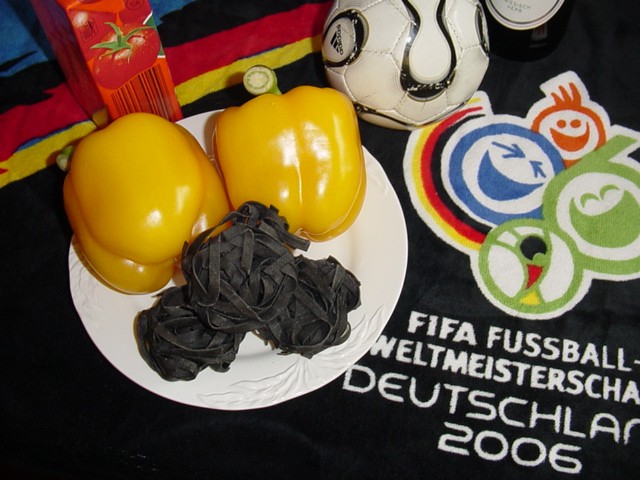
I’m very happy that it’s so international in Germany, and the only reason why I would like to display a Schwarz-Rot-Gold here would be to introduce a bit of variety (4 years ago on a campsite in Dorset, we put a Welsh flag up for that very reason), but this allegedly tolerant society really isn’t when it comes to football – time and time again, German cars are scratched after matches, and my Brazilian friend had a brick through her window when she displayed a Brazilian flag. So I shall keep it all indoors, with my selection of little flags and football inspired food. Today, for the Germany match: Black Tagliatelle, Red Sauce and Yellow Peppers.And as far as support is concerned: this time, for the first time, I really feel I have to support Germany, because Lehmann, their goalie, is from my home town of Essen and used to play (early in his career) for Schwarz-Weiß Essen (in the 4th league, I think), the team my Dad supported. But of course, I’ll be supporting England, when they play, we’ll also look out for Togo and Ghana and any other underdog who takes our fancy. And should Brazil win the World Cup for the 6th time, I won’t cry either – after all, we all know they play the most beautiful game!!

Thursday, May 04, 2006

Henley Food Fair


Andrew from spittoon had invited us to this event way back in December or so, and originally my intentions had been to make a weekend of it, organising it around seeing friends in the area. As it happened, I left arrangements to the last minute (hey, what else is new?), which was just as well, as the friends I had earmarked (ouch!) had just moved into cramped rented accommodation and Tom suddenly developed such severe angina pains that he had to go into hospital. He spent the whole of Easter there and had to have two more stents put in!
However, this sudden heartache had prompted me to send an e-mail to Joanna (a fellow blogger with a sweet-heart problem) who hadn’t posted since January, which had already got me a bit worried. She got back to me immediately, to say that luckily, nothing of the sort had been happening to her husband, and was I coming to the Henley Food Fair, she could pick me up from Reading station. Said and done (as if anything could ever be this straight forward in my household!), after buying a horrendously expensive train ticket - three times as much as my brother recently paid for a three-day trip to Prague, inclusive of bed and breakfast (buffet bar!) in a three star hotel!!
[1] - for a Virgin train (as if I’m not needlessly sponsoring Richard Branson’s Empire enough by paying handsomely for the privilege of my Virgin Active – in Sally’s and my case: Virgin Inactive – membership), I was heading down South.
I had been planning on getting a bit of reading done (admittedly, not Stephen King’s Green Mile, as required by the book group, but Henry James’ The Wings of the Dove), but that turned out harder than anticipated. No, it was not James’ overly baroque style, it was the rather more prosaic mobile and other conversations I was relentlessly subjected to. By the time I arrived in Reading, I knew the entire ins-and-outs of the love-life and domestic arrangements of the two young ladies sitting behind me, AND that of most of their siblings and in-laws, who happened to be scattered around the globe, which made it marginally more interesting than listening to two girls from Balsall Heath.
Joanna and I got straight into medias res, as if we’d known each other for a life-time, and had already covered a lot of ground by the time we met Andrew in the delightful Henley market square, where most of the action took place. As it was rather crowded, we retired to the Queen’s Head, downed a few pints of the local Bitter, Brakspear, and talked ‘shop’ (well, as much shop as one can talk with two muddle heads like Joanna and me, who can cover low cholesterol, techno trouble and the total eclipse of the sun in two swift breath strokes...).

For the actual produce stalls, one had to queue for rather a long time, which we wiled away with wine talk, a.o.th.. Both Andrew and Joanna thought there was probably a good point in my wine-literature analogy (I – just like the average reader who needs characters to identify with, a ‘proper’ plot and a certain page-turner quality – like my wines easy: full, fruity and smooth, whereas a real wine connoisseur would be looking for something with an edge, a bit of a challenge, with subtle and exciting sub-tones – which is what I can appreciate in prose, but clearly not in wine...), and think I should write about it...[2]
Needless to say, I tried loads of food and drink and bought plenty (see above), after all, I had my mini foodie at home to satisfy (Ozzy in reply to “What do you want me to bring back: olives, sausages or cheese?” “All three, Mum!”), leaving Andrew and Joanna to grow roots (sorreeee!).
The eatery tent was filled with food offerings of various provenances, but it was claustrophobically packed and there was nowhere to sit. So, temptation being one thing (AWT’s Thai Beef, for instance), and comfort zone quite another, we headed towards the river for the picturesque outdoor seating area of the Angel on the Bridge. Unfortunately, their pub menu is nothing to write home about, which is a crying shame. You don’t have to be a culinary crusader to feel that any restaurant worth its salt needs to be well reflected in their pub offerings, too. The most interesting dish were Cheese and Jalapeno Bites – they looked like chicken nuggets and contained a bland cream cheese paired with a slice of jalapeno almost cooked to a pulp. Andrew summed it all up like this:

I couldn’t agree more. I had a great time and I’m very much looking forward to the next blog meeting, especially as Johanna couldn’t make it, after all, and we managed to miss Celia.

PS: I didn’t choose my photograph of Joanna and Andrew because it’s not focussed.... (stop sniggering, you two!!)

[1] Okay, so it was a coach journey, starting out from Germany, but still!!!
[2] I have a feeling it would read like this:

Freixenet Cava, Rosado Seco:
“Jilly Cooper”
- light weight, but by no means without (predictable) character(s) and sparkle; so easy to drink, you’ll be asking where the rest of the bottle went; won’t fail to get you into the mood for you know what...

Lacoste-Borie, Pauillac, 1997:
“James Joyce” - unless you can distinguish between your nose and your body: startlingly edgy; this one will prove fairly impenetrable to the untrained palate, but at 12.5% guaranteed to get you pissed...

And I’m not sure this would be anybody’s cup of wine!